Pages

Showing posts with label Marvel Comics. Show all posts

April Special: Marvel's Razorback


Overview

Whenever you see one of those lists of "lamest superheroes" there's a really good chance that somewhere on there you'll find Buford T. Hollis AKA The Razorback.  That's a shame.  Being an Arkie myself, I've always had a fond spot for the Razorback because of his name (if nothing else).  However, I don't think that's all there is to commend him.

Gilgamesh
When it comes to costume looks, I understand that mileage varies, but to me Razorback always had an appealing look just because it was so...bizarrely different.  Marvel briefly attempted something similar with Gilgamesh...but who are we kiddin'?  That lame allusive bull-head ain't got nothin' on Buford's glorious man-beast headgear!

Aside from his fetching headdress, I thought the Razorback had a good color scheme.  I tend to like heroes in green anyways (e.g., Green Lantern, Green Arrow, Fire, Mantis, Gamora, Drax, etc.) but the green and brown bespeak a earthy sorta guy.  If a dude named Buford became a superhero, I'd totally expect him to have a costume that made great use of camo color combinations.

So with all these positives, what's not to like about Razorback?  Well...his one mind-boggling failure is his powerset.  Now with a name (and look) like what we see above, what would you expect?  A guy with super-strength...maybe a super-tough hide.  Somebody along the lines of Power-Man...or maybe Wolverine sans the claws and adamantium skeleton?  That would be logical.  That would make sense with his name....but no.

Razorback's mutant power was...the ability to drive any kind of vehicle.  [crickets]  Yep.  You read that right.   Now, in fairness...prior to the manifestation of his mutant power, Buford was already an all-star athlete.  So, he's got some pretty solid physical strength and endurance...it's just not superhuman.  Fair enough.  That basically puts him in the class of guys like Hawkeye, the Punisher, etc.  (though probably sans the combat training of those guys.)

Since ComicVine lists no creator(s) for the Razorback, I can only assume that credit for his being is due to everyone on the credits line of his inaugural appearance (summarized below).  If that is correct, then Buford T. Hollis' four daddies are:  Bill Mantlo, Sal Buscema, Mike Esposito, and Archie Goodwin.  Additionally, two (presumably) ladies also appear on the byline, but their last names are not given.  (I wouldn't want to be in the HR meeting discussing this one after the fact).  Can anybody out there help me with the identification of Annette K. and Janice C. ?

Anywho,  I like the Razorback...and I hope you will too.  Read on for my synopsis of his first appearance, and some Razorback fan art by my kids.

First Appearance


The inaugural appearance of the Razorback was in  The Spectacular Spider-Man #13 (DEC 1977).  [Interestingly, this makes the Razorback and I almost the same age.  Doubly-interesting because I grew up only an hour from the Razorback's supposed place of origin (i.e., Texarkana, AR).]

This issue opens with Spidey picking himself up off the ground in a trash-strewn alley.  Apparently, he was blasted out there during a confrontation with Brother Power and Sister Sun (in the previous issue).

Stilled addled, when his Spider-sense starts tingling the Wall Crawler assumes Brother Power has followed him into the alley to finish him off.  Rather than waiting for his vision to clear, Spidey decides to get the drop on this attacker by throwing the first punch.  Unfortunately, as he discovers, this "somebody big" isn't Brother Power!

Thus, the Razorback is
introduced (in truly painful
hackneyed "Trucker lingo.")


Razorback grabs the web-head by his noggin and hurls him across the alley.  Sailing through the air, Spidey grabs hold of a light post, using it and his momentum to swing back and plant a crushing blow into Razorback's chest.  This is enough to launch the porcine paladin through the front window of Brother Power's restaurant.

The Wall Crawler follows, intending to finish off Razorback quickly so he can, "get back upstairs" to "save Flash."  (I guess Flash Thompson got himself in a some sort of a jam in the previous issue.)  When Spider-Man takes hold of his still prone foe, we're introduced to another little trick of the Razorback
Of course he has an electric mane..  You know, just like the
native razorback?!
As the Spider is twitching and writhing on the floor to shake off the effects of the shock, his sparring opponent suddenly gets all chummy.  First we learn that he built his electrified mane out of spare radio parts.  Razorback opines, "if that don't prove I belong in the big times, ain't nuthin' will!"  (I don't know, pal.  That seems like kind of a low bar to decide you're ready to tangle with the likes of Dr. Doom, Thanos, et. al.  but whatever)

Razorback tells Spidey he, "don't hold no grudges" since he understands that, "all you eastern superhero types always stomp each other by way o' introduction!"  With that, the hogshead hero extends a hand to help Spidey up off the floor, while--for reasons that utterly escape me--revealing his real name is Buford T. Hollis from Texarkana, AR.

Okay, so...it's a weird introduction.  But rather than being gracious, the webhead gets simultaneously self-righteous and self-centered, accusing Razorback of "pick[ing] a fight just to get to know me!"  (Apparently, getting tazed by the electric mane cause Spidey to forget that he threw the opening punch of this little tussle.)

After his atypically un-heroic outburst, Spidey charges upstairs to find a beaten and addled (but still breathing) Flash Thompson.  Flash explains that while Brother Power was using his head as punching bag, he and Sha Shan (Sister Sun) suddenly stopped cold--like they were listening to a voice from elsewhere--before suddenly fleeing.

Spider-Man starts to question Flash further, but that is cut short by the sight of Brother Power's sedan laying rubber on the street.  Just as he's about to web after the car, Spidey is stopped by a big gloved hand attached to an even bigger fella.   Again, Spidey initially reacts with jerkishness, calling Razorback an, "overgrown corn-fed hayseed" before shutting up long enough for RB to explain, "I'm just tryin' to save ya a trip -- sort of by way o' apologizin'!"  (Again...not really sure what Razorback is needing to apologize for here.)

Anyway, the Master of  Taxidermy explains that he's placed a tracer on Brother Power's car.  Without bothering to issue his own (more warranted) apology, Spidey finally admits, "not bad at all, Tusks" before changing the subject by asking why Razorback is after Brother Power.  The Swooieee Sentinel merely repeats his earlier ambiguous claim that, "it's family business."

Spider-Man let's the whole question of motivation drop as quickly as it arose when Flash Thompson comes running up demanding to be included if the two animal-themed adventurers are "going after Sha Shan."  Amazingly, Spider-Man says, "Why not?...Three can afford the cab fare easier than one!" (What?!  This dude was just near-unconscious in an upstairs room, but sure let the un-powered civilian tag along for a confrontation with a super-villain?!)  As it turns out, the trio will get to save their cab fare 'cause RB has some wheels of his own.

It's like a grain combine had a secret love child with a Peterbilt...
and it was one ugly baby.

They rollout in the "fastest semi-rig north, east, south, or west of T-City, Arkansas" (by the way, as a native of the area, I don't believe I ever heard anyone refer to Texarkana as "T-City") in pursuit of Brother Power.  Oh and, just because, we're treated to a panel of the Big Pig popping a wheelie!

Meanwhile, north of the city, Brother Power & Sister Sun arrive at a fancy schmancy Croton-on-the-Hudson estate.  As they enter, an underling informs them that their superior (as yet unidentified) is awaiting to personally express his displeasure at their performance.

Though Brother Power starts to accuse the underling of scheming against him, that's cut short when the Big Bad reveals himself and condemns Brother Power for having defied his orders not to utilize his superhuman powers in public.  And that Big Bad is none other than...

Am I the only one who found it super-corny that the Hate-Monger had
a giant "H" on his chest?

Despite Brother Power's braggadocio, a quick pimp power blast from the Hate Monger puts the little underling back in his place.  Then, to twist the knife a bit more, the ol' Violent Violet informs BP that not only did he violate the first rule of Fight Club the Legion of Light, he also managed to lead "outsiders" to their little retreat.  Quicker than a knife fight in a phone booth, Brother Power is back to grovelling and begging the Hate Monger to, "let me do penance by destroying these interlopers!"

Meanwhile, said interlopers are...


No...not those guys.  These  guys:


We find out that the picture of the runaway taped to the dash is of Razorback's sister, one Bobbie Sue (because of course that's her name).  So Bobbie Sue--we'll just call her B.S. for short๐Ÿ˜--joined up with Brother Power's cult and was brainwashed into cutting all ties with her family.  (Cult brainwashing stories were all over the news in the 70s and 80s.)  By the time he found out where they'd stashed his little sister, the Legion of Light was gone--and they'd taken their little B.S. with them! (See what I did there?)

Buford, being the rational chap he was, "figgered" that since he had some big muscles, had a knack for building things, and "had stopped a gang of radio rustlers smugglin' hot CB equipment across state lines," he could just put on a hogs head and track his sister down.  (No, I'm not making up that part about the radio rustlers. That is actually in the comic.)

Having finished his rather weird origin story, Razorback gives Flash an opening to explain the back story of himself, Sha Shan, and the Legion.  We learn that Sha was the daughter of a reclusive Vietnamese mystic.  One day her pops summoned Sha and told her, "there is a precarious balance on earth between good and evil."  Dear ol' dad goes on to explain that a Lord of Darkness has descended to earth and chosen a mortal as his emissary of hate.  For some unexplained reason, however, this emissary has been given power that he won't actually be able to use unless joined to one of purity and innocence. And...you guessed it...Sha Shan "has" to be the one to marry this dweeb of darkness in order to preserve the all-important balance.  Oh and by the way, Sha Shan's dad tells her he doesn't have long to live.  Well Brother Power (the aforementioned dweeb) shows up, marries Sha, and they flee just before the temple is destroyed in the last bombing of the Vietnam War.

About the time Flash's story ends, the Big Pig rolls to a stop on a hill overlooking the Hate-Monger's hacienda.

This doesn't seem like a sufficiently stealthy approach to me.  You?
Spidey pretty quickly reins in Razorback's enthusiasm to charge in (metaphorical) guns blazing by reminding him, "we're on private property now--and the Legion hasn't broken any laws!"  (Well...except for that part where they had Flash tied up in a room above a restaurant beating the crap out of him, but...little details I guess.)

Spidey manages to walk across a remarkably low-hanging telephone line in what looks like broad daylight without being seen by any of the confessedly beefed up security.

Maybe his words are nicer,
but Spidey's still thinking 
self-righteously.

Arriving outside a upper-floor window, Spidey is shocked to see the Brother Power and Sister Sun in the same room with the supposedly-dead Hate-Monger!

HM spouts the standard bad guy pablum about how the Legion's "gullible" followers will see his appearance at a planned rally the following day as, "the greatest manifestation of the power of the light! But they...will learn that it is really the power of hate...and swiftly feel just how great that power truly is!"

Deciding hanging out with a wanted criminal--even a dead one--is sufficient evidence against the Legion of Light, Spidey tries to make his way back to Razorback and Flash.  Unfortunately for the Wall Crawler, a searing jolt of electricity runs down the "telephone" line shocking the arachnid and sending him crashing through the roof and into a shed adjacent to the main house.

Back on the hillside, Flash and Razorback witness a bright flash of light and conclude their pal has gotten in trouble and needs some back-up.  Unfortunately for the not-quite-dynamic duo, they're almost immediately surrounded by a legion of club-wielding legionnaires.

This odds are lookin' pretty lopsided to me, but ya gotta admire the Pork
Protector's moxie!

Back at the shed, Spider-Man finds himself in pitch darkness (which is odd, since it sure looks like it's daytime outside and he did fall straight through the roof--I mean, wouldn't you expect some sunlight would make it through?  But I digress.)  That doesn't last long, however, as the lights suddenly flick on to reveal Brother Power and Sister Sun in a joint attack on the Webslinger!  They reveal that everything Spidey overheard was part of an elaborate trap using decoys.  All the while, BP and SS were waiting in the shed for him to come crashing through the roof so they could blast him with their light powers.  (๐Ÿ˜” Ahhhh.  Okay. And how did Hate-Monger know precisely the route that Spidey would take retreating from the house?  In order to work properly this "plan" seems to require a Calvinist God-level of foreknowledge.  I wasn't aware that the HM supposedly had that ability.)

Up on the hillside, Flash and Buford (more accurately--Buford) are giving the Legion of Light storm-troopers the ol' what-for.  Between his electric mane and fisticuffs, Razorbacks got bodies hittin' the floor (well, okay, the ground) right and left.  His fighting frenzy is momentarily stayed, however, when he spots his missing little sister, Bobbie Sue.  This turns out to be a bad life decision.


Our next panels are a series of head shots of the Hate-Monger.  He's thanking Spider-Man and his (perhaps less-than-amazing) friends for attacking his residence so directly.  By doing this, HM says, they've played into his hands.  Now even more people will tune in to watch his televised rally because they'll just be curious to know, "what manner of organization inspires such horrible acts of mindless violence!"


Leir the Lady's Man: (Marvel) part 6


The Mighty Thor #417 (MAY 1990)

The sixth appearance of everybody's favorite lightning slinging Celt, is in a back-up story from The Mighty Thor #417.  (For Leir's previous appearances, see here)

At this time, Asgard was adrift in the Negative Zone, consequently obstructing passage from Asgard to Midgard (i.e., the realm of Earth).  In the Golden Realm, the Lady Sif pines away for her beloved Thor (who is on the other side of this dimensional barrier).

In Avalon, the Celtic gods have learned of the Asgardians' inter-dimensional wanderings; and the reader learns that Leir has, "fallen (swollen) head over heels" for Sif.  Somehow or other, the Tuatha de Danaan open a portal to Asgard, which Leir promptly charges through in order to claim his "chosen" wife.

I'm curious how that was pulled off.  If Asgard is inaccessible from earth, I would've expected it to be cut off from Avalon as well.  Maybe Dagda is way more powerful than I realize.

Leir shows up outside Sif's chambers, pompously announcing the great honor and joy she ought to feel at having been "chosen" to be his bride.


While Leir's busy with Sif, Caber (who, like any good wingman, has followed his buddy through the portal in the vain attempt to keep him out of trouble) has gotten into a stand-off with the Warriors Three.  The only thing that saves the fleet-footed Celt is the timely arrival of the now-happily(?) engaged couple!


Leir (Marvel): part 5

Marvel Comics Presents #30 (OCT 1989)
The fifth appearance of Marvel's Leir (lord of lightning and god of the spear!!) was an odd-little tale in the monthly anthology, Marvel Comics Presents.  Like many MCP stories, this one felt like a throw-back to the old standalone Golden Age tales.  It takes up a mere 8 pages...and by the time you finish it, you may wonder why those 8 were so utilized.

As the above splash page depicts, the story launches with Leir fighting a monster.  When the monster mysteriously disappears just before Leir can destroy it (essentially rehashing Leir's introduction to the Marvel universe), our hero is fuming.  This is despite the best attempts of Dagda (leader of the Celtic gods) to congratulate him on a job well done.

Dagda explains that the creature was sent by the Fomorians, ancient enemies of the Celts.  It's not explained why Dagda shares this information.  One might assume it's because he wants to support Leir's desire for vengeance.  However, when Leir (accompanied by Caber) travels to the realm of the Fomorians and is on the verge of victory, he is driven back--by Dagda!?!


Leir's question is perfectly valid.  I've got a follow-up: 
Does Dagda have a split personality...or does he just enjoy jerking Leir around?

In the words of SuperMegaMonkey, "that, without a doubt, was a story that lasted eight pages."


Leir (Marvel): part 3


The third appearance of Marvel's Leir, came in The Mighty Thor #400 (FEB 1989)This wrapped up the arc that saw the Egyptian death god Seth threatening all life.

As issue #400 begins, Thor (to whom Odin had previously imparted the Odinforce) is engaged in a cosmos-spanning battle against the All-Father's eternal enemy, Surtur the Fire Demon.  As for Odin himself, the true liege of Asgard has returned to his shattered home to rally its defenders.

Leir is...well...he's being Leir.  But at least his Caber finally said what we've all been thinking:


While Caber is launching his one-man intervention, the Earth Force in a final act of rebellion attacks their creator Seth.  Sadly, despite their nobility, none of the three possess anywhere near the power necessary to defeat the death god.

With the Earth Force dispatched, Odin steps into the gap to tackle Seth in a mano-a-mano fight, proving that even without the Odinforce, the old guy's nothing to sneeze at.   Nevertheless, the sudden appearance of the dimension-hopping battle betwixt Thor and Surtur momentarily distracts Odin, allowing Seth to seize the upper-hand and potentially kill the Lord of Asgard.

At this dramatic apex, DeFalco does a great job (IMHO) of supplying deliverance from very unexpected sources.  The Black Knight, who has been struggling against the slow advance of the ebony blade curse--which has been turning him into an extension of that mystic blade--is completely paralyzed.  Hogun the Grim, who we've been repeatedly reminded is "marked for death" by Seth, decides to accept his fate by launching one last assault on Seth in an effort to save Odin.
Hurling the paralyzed Knight like a spear, the mystic properties of the ebony blade are able to pierce Seth's head, killing the death god.


 Following the defeat of Seth, and the (momentary) knocking out of Surtur, the Thor returns the Odinforce to his father.  Odin, in turn, serves as the deus ex machina by "absorbing the very essence" of Surtur into himself, so as to imprison the fire demon forever.  (Of course, if defeating Surtur was this easy, it begs the question why Odin didn't do it millennia ago.)

Note the largely tertiary Leir positioned behind Fandral, while Caber is on the other side of the panel.  Maybe the "lord of lightning and god of the spear" didn't appreciate being reprimanded?


Other sources on The Mighty Thor #400

Leir (Marvel) : part 2

In a previous post, I introduced Marvel's largely-forgotten Celtic Thor-analog, Leir.  Today, we examine Leir's second appearance in The Mighty Thor #398 (DEC 1988).  This took place roughly a year after his introduction, in the full-flowering of a story arc that was seeded back during Leir's first appearance.


As Thor #398 commences Asgard is under siege by the forces of the Egyptian death god Seth.  The status of the Golden Realm is quite precarious as neither Odin nor Thor are present in this hour of greatest need.  Owing to the destruction of the Bifrost Bridge, Thor and a coterie of allies (specifically, the Black Knight, Earth Lord, Wind Warrior, and Skyhawk) apply a little reverse psychology to Seth's pretentiously-named minion, Grog the God-Smasher.

When the imprisoned Grog takes advantage of a momentary freedom by opening a mystic portal to the Heliopolitan cosmological plane, Thor and company follow him and are immediately engaged in a titanic battle with Seth's forces.  After locating the death god's "secret weapon" (in the person of Bes) Thor ultimately frees the imprisoned Odin.

Meanwhile back in Asgard, the Golden Realm teeters near collapse.   A rout seems all but certain following the grave wounding of Balder (temporary ruler of Asgard) and the apparent death of Heimdall.  This latter is too much for the Enchantress, who lets out a primal dimension-piercing scream before charging headlong against Seth himself, in order to avenge her brother.

While Amara's attack is a spectacular failure, her war scream turns out to be much more productive.  Though many beings in many realms hear the Enchantress's scream, only the Tuatha de Danaan respond...and I bet you can guess who's in the lead of the relief forces.


Leir (Marvel) : part 1


Character Overview

The incredibly cool-looking character depicted above is the aggressive (but curiously underused) Leir, lord of lightning and god of the spear.

According to Comic Vine:
Except for his much greater size, Leir is in many ways a Celtic version of Thor. He possesses strength, durability and other physical abilities that rival those of Thor. His most notable power is the ability to produce long, lightning-like spears that he uses to hurl at his enemies. Backed by his vast superhuman strength, these spears can shatter nearly any substance and have at least similar destructive power as Thor throwing his hammer. It is unknown if Leir has other elemental/weather powers.
When you do a little research on the mythological source material, you quickly find differences between the comic version and the real world traditions.  First, there are several alternate spellings of the name (e.g., Leir, Lir, Ler, Llyr, et al.)  More significantly, however, there seems to be some serious differences in domain of authority.  As near as I've been able to tell, Leir was typically considered a sea god by the ancient Celts/Irish.


Comic Vine explains this by proclaiming Leir a "former god of the sea," who sired "several gods and eventually turned his duties of god of the sea over to one of them..."  So...what, is this supposed to be like a semi-retirement?!  If so, I'd be curious to Leir would do this.

His depiction in the comics doesn't look much like a retirement. He's so "out front" and aggressive, in fact, I initially assumed he was leader of the Celtic gods.  In reality, he's something nearer to a war-leader--skilled as a fighter and strategist, but too impetuous and hot-tempered for the diplomatic aspects of leadership.


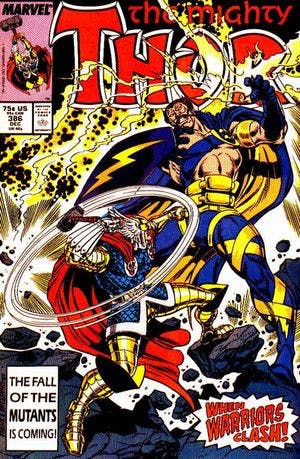
The Mighty Thor #386 (DEC 1987)
Created by Tom DeFalco and Ron Frenz in 1987, Leir's first appearance was in The Mighty Thor #386, labelled by SuperMegaMonkey, "the first 'real' issue of the DeFalco/Frenz run."

The story begins rather mundanely, as Thor has his beard shaved.  This is part of a reset from Hela-induced vulnerabilities that had lead to having a host of facial scars (hence, the beard) and brittle bones (hence the adoption of battle armor--which Thor will chuck by the end of this issue).

Goldilocks is about to head back to earth, when the Warriors Three convince him to go on one last excursion.  In the process, they come across (well...technically, I suppose Thor comes across) a giant, black sphinx-looking monster terrorizing the Asgardian countryside.


No sooner does Thor engage the creature, before it retreats through a dimensional rift.  Though the Warriors Three protest that Thor should allow them to accompany him into this unknown realm, the Avenger explains they must remain behind to defend Asgard in the event Thor fails to defeat the monster.


Thus, the Odinson is all by his lonesome when he emerges in the land of Avalon, home of the Tuatha de Danaan (i.e., Celtic gods), long-time enemies of Asgard.

Given that background, Thor receives the "welcome" you would expect...and that from Avalon's fiercest defender:

Among other things, this issue provides evidence that
from the very beginning, Leir was using his groan-worthy
introduction.


Naturally, Thor tries to explain this is all a misunderstanding...and of course Leir ain't havin' none of it and they thrown down.  Eventually, of course, the Sphinxster shows up again. Leir realizes Thor's telling the truth, and the two set aside their differences to fight it.

Though they put up a great fight, the beast is not finally put down by Thor, Leir, and Hogun (who had previously passed through the portal into Avalon to aid Thor)  contribution to the story.  Instead, the beast retreats back through the portal to Asgard.  Thor and Hogun give chase, only to find that this monstrous threat has been easily dispatched by Volstagg and Fandral.


As it turns out, this one-off story ends up being very fortuitous for it allows a sort of "peace" to be established between Asgard and Avalon. 

Other sources on Thor #386


The Swordsman Shanked my Idealism

Though the Swordsman was long gone from active duty Avengers roster when I entered comic-dom, the character appealed to me from the moment I first saw his headshot in one of those "all-time Avengers" compilations that would occasionally crop up.

Part of it was that I tended to like any skill-based hero (e.g., Captain America, Hawkeye, Batman, etc.). Second--as the existence of this blog attests--I always favored the marginalized or "second-string" characters.

Avengers Spotlight #22 (SEP 1989)
So perhaps you'll understand how underwhelming it was when I finally got to read a Swordsman story (in Avengers Spotlight #22).  Initially, I thought this might simply have been a one-off origin stinker. (After all, I think it's pretty difficult to make an origin story really engaging.)  But alas...the more I read about Jacques Duquesne, the less..."heroic" the hero seems.

It's not just that Swordsman is an anti-hero in the mold of Punisher, Lobo, Paladin, etc., but rather that he just seems to have no core convictions at all.  Just read the Comic Vine entry on the guy and look at how many times he tried for the Avengers, got rejected, committed some crime in response, latter joined, then got kicked out, etc.  It's a terrible farce.

If they weren't going to make Swordsman heroic, I like to think he could've at least been interesting.  He might've worked as the superhero version of having an addict in the family...someone who struggles, really tries to do right, but just keeps failing and failing.  Increasing nuance and complexity in how the Avengers (both individually and as a team) chose to respond to their dysfunctional comrade might've made an interesting commentary on enabling, intervention, etc.

But instead, I feel like we just got a poorly-written, second-tier guy with a sword...and then he died.

Anyone care to disagree?  I'd love to be shown "the error of my ways" on this one.

On Vagabond's costume change in the late 1980s


Priscilla Lyons (Vagabond) first appeared in Captain America #325 (January 1987)
At that time, she was simply an anxious older sister hitchhiking to Miami to rescue her brother who'd fallen in with crimelord Ulysses X. Lugman (AKA -- The Slug). She was picked up by Nomad (Jack Munroe) in Kentucky and after relating her story, Nomad offered to investigate on her behalf.

Despite being surprised at Nomad's I-wanna-be-just-like-Magnum-P.I.-moustache, I was even more put off by the somewhat ambiguous quid pro quo here.  Did Nomad decide to help Priscilla and she simply kissed him in gratitude...or is there something a bit more...adult implied here?


Priscilla's next appearance (and her first in costume as Vagabond) comes almost a year later in Captain America #336 (December 1987).  In the interim, Steve Rogers has surrendered the Captain America identity and is wandering somewhat aimlessly across America.  Concerned for Rogers, three former partners:  Nomad, Falcon, and D-Man have teamed up to search for him.  Nomad brings Priscilla along for the ride, who has by this time adopted the costumed identity of Vagabond, featuring an outfit obviously inspired by her lover's.


This was also the first time Cap actually met Priscilla.  (During the great rescue-Nomad-from-the-Slug caper, Priscilla had only called Cap's hotline then.)


Since Priscilla has nothing more than a domino mask, Cap has the good sense to forbid her from tagging along when he and partners take on a group of serpent-themed super-villains in Captain America #337 (January 1987).  (You'd think this is the kind of solicitous concern that...I don't know...maybe a boyfriend would point out!  Hello Nomad?  Are ya listening?)

Priscilla's mimickry of Nomad lasted until Captain America #342 when she changed her costume to the red-white-and-blue themed workout duds she sports in this entry from The Official Handbook of the Marvel Universe:


I had started regularly collecting Captain America only a couple of issues earlier (i.e., with #340)  At the time, most of Cap's entourage appealed to me precisely because--with the exception of D-Man--they were not "super-powered."  Vagabond, however, was in a class by herself.  She basically had nothing but a mask and a fighting spirit.  She didn't even carry a particularly techie gadget or anything.  As a rather non-athletic little dude myself, I felt a gut-level admiration for this "normal" young woman who wanted to put herself in harm's way purely in the service of justice.  Vagabond was inspiring in a way that not even Cap was.  She was, literally, the "every (wo)man" of the group.  

To the best of my knowledge, the costume change in issue #342 was never explicitly explained.  I'm wondering if this was a case of the art being used to imply some character development.  In other words, was the costume change intended to represent Vagabond growing into her own person--rather than just being a "plus one" for Nomad--as she observed her lover in contrast to his peers and made the choice to pattern herself after Steve Rogers rather than Jack Monroe?

Of course, the fly-in-the-ointment with this interpretation is that this was precisely the time when Rogers himself was wearing the darker garb of his Captain persona (later adopted by the USAgent).  So maybe this artistic decision was as simple as the editorial staff saying, "Hey, we call this book 'Captain America' so maybe somebody on this team outta be wearing red-white-and-blue!"

I know I like my interpretation better...but what say you?


Around the Web: rise and fall of the Marvel Universe

A while back I read this great analysis on what went wrong with Marvel Comics by Chris Tolworthy.  Its a part of his larger website dedicated to the Fantastic Four--especially a celebration of their early years.

Admittedly, this is a long read...but if you nerd out over this stuff like I do, I think you'll find it worth the time investment.  Basically, Tolworthy's premise is that the thing that really made Marvel stand out from DC originally was grounding stories in space and time and a commitment to storyline continuity--across all the Marvel titles.   This meant that characters and story plots could emerge over years...decades even.  Characters grew and changed.  They made choices and those choices had real consequences that affected the entire Marvel universe...much like real life.

My sense is that Tolworthy's critique is pretty accurate.  I know when I got into comics in the late 80s, one of the things that really intrigued me (and kept me spending hours in the comic shop) was the interconnectedness of the Marvel universe.  I wanted to go back and guy all kinds of back issues to fill in gaps...and doing so never felt like wasted effort.  I saw myself as being progressively initiated into the literature of Marvel. 

Probably the single most critical factor in killing my passion for Marvel comics--even beyond the ridiculously jacked up prices--was the hatchet job they did on continuity.  Nothing seems important anymore because everything changes all the time...and no story line can be assumed to have any long-term significance.  When that's what you've created...who wants to spend even $4-5 per issue?  Not only is it not a sound financial "investment" (which, of course, was a ridiculous notion in the first place) it's not even a sound entertainment/literary investment. 

Do you guys think?