Pages

Showing posts with label reviews. Show all posts

Brass Falcon: a webcomic review

Written by Craig Sardone with art by Alex Williamson, Brass Falcon is set in fictional Sun City. Though the site indicates there are two full issues available, in reality, Issue #1 is just an expansion of the #0 issue.


The lone story available, opens on a dock scene wherein General Nimbosa (of the fictional African country, Nobinia) is on hand to purchase a bioweapon--a plague engineered to specifically target the general's tribal enemies, the Bejarra--from Sun City mobster Vincent "Vinny" Toretta.


Shortly after the villains inject their captive Bejarran guinea pig, the titular hero comes crashing through a skylight in dramatic fashion.

As it turns out, this is also the last full color page of the comic.


In the ensuing fight, Brass Falcon demonstrates standard Superman-esque powers:  flight, super-speed, some degree of invulnerability, energy-projection, and super-strength. Toretta quickly flees the scene, leaving General Nimbosa and the majority of his hapless minions to get trounced.

Nimbosa taunts Brass Falcon, claiming that his "diplomatic status" makes him effectively untouchable under any legal jurisdiction. Before Falcon can really respond, his attention is diverted by the poor Bejarran's real-time desiccation.


Furious at both Nimbosa's inhumanity (and, one suspects, his own helplessness) Brass Falcon destroys the remaining stock of plague with an energy blast, then leaves the general tied to a barrel or something for pick up by the Sun City PD.  Nimbosa issues standard bluster about "see[ing] you dead for this indignity," blah blah blah.

Is it just me, or does this panel look like BF is threatening to "hold" Nimbosa with a water-cooler jug?  I don't what understand the art is supposed to be telling me.

In the aftermath, police descend on the flaming warehouse en masse.  This provides an introduction to Joe and Jimmy Valentine--brothers who are both detectives with the Sun City PD, extending a family tradition of law enforcement service.  That, it appears, is the extent of their similarities.

Jimmy comes across as the clean-shaven rule-following super-cop.  (If Steve Rogers were a police detective, his name would be Jimmy Valentine.)  Joe, in contrast, is the quintessential guy you love to hate--a chauvinist, dirty cop on the take from the mob.


The story picks up the following morning with each Valentine brother discussing the previous evening's events over breakfast.  Joe's father invites his son to drop by the house for a home-cooked meal, and encourages him to work through whatever issues have opened the rift between himself and his brother.  After leaving the diner, Joe reverts to his dark side as he and his partner head out in their unofficial capacity as enforcers for Vinny Toretta to shake down a rival gang of drug dealers.


Meanwhile, across town, Jimmy is chowing down with his grandfather who warns the young detective against the perils of taking a "whatever means necessary" approach to police work.

When Jimmy returns to the police station, he is greeted by of flowers from yet another grateful citizen who secured justice thanks to his efforts.


Sadly, this moment of reverie is shattered by the image of the hulking General Nimbosa arrogantly striding out of the station.  When Jimmy tells the would-be genocidal maniac that he "will not get away with this," Nimbosa responds much as he did to Brass Falcon in the warehouse.  He. is. untouchable.  As if to underscore just how "above the law" Nimbosa soars, Williamson & Sardone treat us to the following panel.


While we leave Jimmy to stew in the juices of his righteous indignation, the story cuts back to Joe and his partner who have apparently been summoned to a warehouse meeting with Vinny Toretta.  There they find not only Sun City's worst, but apparently Nimbosa's as well.

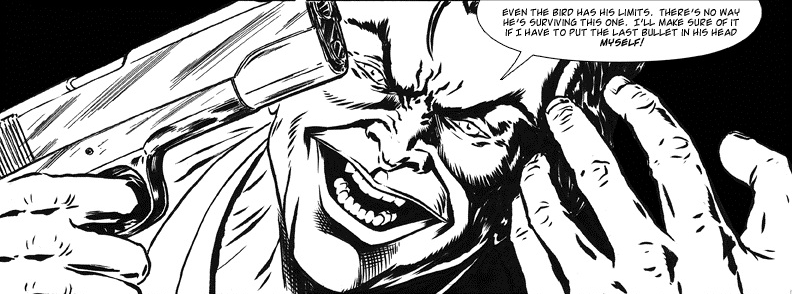
Still stinging from his humiliation by the Brass Falcon, Nimbosa has agreed to supply his own elite soldiers and military-grade weapons in order to execute the heroic ultra.  Joe announces that he has an idea of how they might lure the Falcon into their trap without simultaneously calling in every cop in Sun City as well...though he admits skepticism as to whether even Nimbosa's arms will be enough to do the job. The final panel struck me as oddly anticlimactic. The close-up of Toretta is clearly intended to heighten the dramatic tension, but for me it just seemed a little to...predictable?


Unfortunately--and to the eternal chagrin of Paul Harvey--it looks like we won't get the chance to hear "the rest of the story."  The last posting to the Brass Falcon Blog was in August 2012.  Maybe all Brass Falcon needs to be rejuvenated is a cool theme song. 

Maybe the Beastie Boys are available....monkeys...falcons...they're all the same, right?


Heroic Shenanigans: a webcomic review


Synopsis Review

Heroic Shenanigans is a very kid-friendly webcomic produced by Florida-based graphic designer, Haley Martin.  It narrates the experiences of super-powered kids at the highly-selective Camp Kapow.  The camp's mission follows the standard trope of training youngsters with special abilities to use their powers for good rather than evil (e.g., Xavier's School for Gifted Youngsters, Hogwart's School of Witchcraft and Wizardry, et al).  In the case of Camp Kapow, the specific end goal is for the campers to earn their "hero license."  Central figures are the overachieving (and somewhat precocious) speedster Henry ; Kate, the self-conscious pyrokinetic ; and the exceedingly quiet wall-flower-with-super-senses, Emily.

Since launching the comic (just a little over a year ago), Martin has completed a prologue and three chapters and is in process on the fourth. Though the art is more cartoony and has much less in the way of backgrounds than I prefer, she has seeded a number of sub-plots that I'm interested to see play out. Chief among these is the true aim of Desmond, son of a former hero-turned-villain Charismatic camp counselor, Zenithal Zephyr supposedly pulled a "Harry Potter" when--as a camper--he uncovered and thwarted a plot by Desmond's father to "take...out [the campers] before they became strong enough to oppose his villainous ways."
Sustainability - 4
Martin's been faithfully banging out these pages for over a year.  She regularly posts and appears to have a focused story she's unfolding.  
Language - 5
HS is a very family-friendly comic in terms of language.  I wouldn't have any concerns about letting little kids read it.
Violence - 5
Similar to the language rating, there's nothing to worry about here. To be honest, I'd prefer a little more action/violence than what Martin has given us so far.

Sexuality - 5

As with Language and Violence, there's so far been nothing to worry about on this friend.  HS is, thus far, an extremely G-rated production.

Political Leanings -3
For the most part, there's no real political agenda evident in HS. (Which is a statement that shouldn't be as shockingly refreshing in the world of comics as it is).

Morality - 5

To this point, the moral messages of the comic seem pretty solid.  If anything, I'd appreciate a bit more action and bit less (or at least less obvious) moralizing...but that's really a little thing to critique.  Martin's characters role model common interpersonal problems.  Henry is ambitious and eager to please.  He means well, but his singular focus sometimes interferes with his ability to slow down and listen.  Emily is the picture of "quiet waters running deep."  She has a lot to contribute, but has to learn some self-confidence and actually speak up in order for others to actually benefit from her insights. Kate puts up a tough front to compensate for her own insecurities and self-doubt.  She has to learn to overcome that...to trust enough to drop the walls sometimes so that other can help.

Artwork - 1

The artwork is the weakest part of the comic.  It's extremely cartoony...minimal backgrounds and occasionally pretty bad anatomy (though that's, admittedly, rare).  Of course, everyone doesn't have the same taste in artwork.  If you're looking for something with more of a light, innocent, look HS might be right up your alley.

Storytelling - 2.5

I agonized a bit over the storytelling rating.  Martin's work isn't bad....but neither is it really exceptional.  It may be heading that direction (I can certainly see some potential for real interesting stuff with the Deluca - Zenithal backstory.) but for right now, a 2.5 is the best rating I can justify.

Overall Rating - 3.8

Liberty Lass: a webcomic review

Synopsis Review


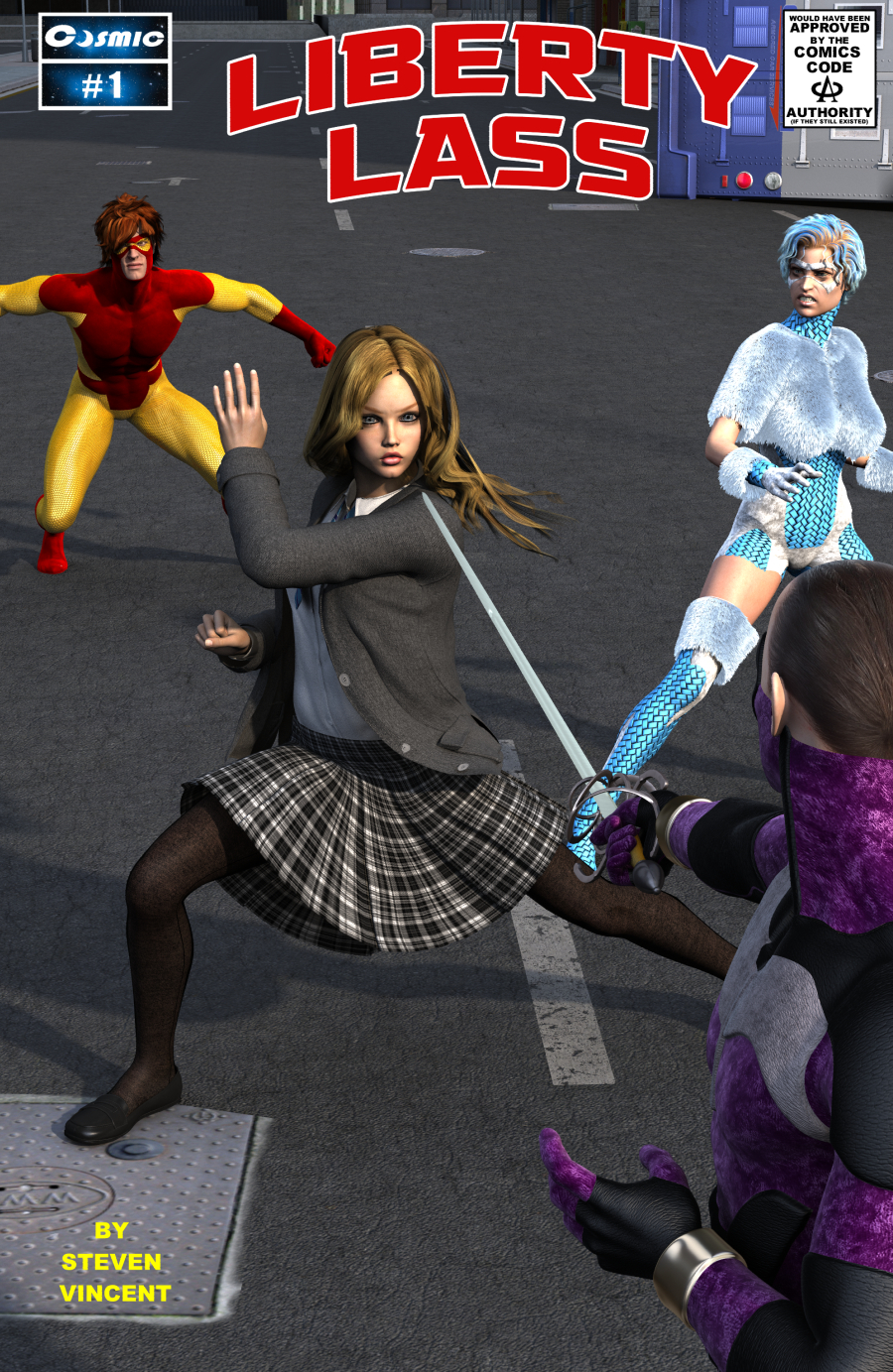
Liberty Lass is an unapologetic celebration of patriotism, cast in the Comics Code compliant style of Bronze Age. Creator Steve Vincent's love for Bronze Age comics goes so far that he even has a fictional company--the Cosmic Comic Company--that "produces" the title. Liberty Lass is a character originally generated for the online gaming world, City of Heroes. Currently, Vincent has produced five full issues of Liberty Lass.


Issue 1: Birthright, part one: self evident truths introduces us to U.S. history nerd Abigail "Abby" Madison who, while en route to get a simple chocolate shake, happens upon the attempted robbery of an armored car by the Rapscallions, a trio of super villains.  The leader, Jackal, initially promises no harm will come to bystanders, but makes clear this is contingent on "not trying anything stupid."

It being the 21st century and all, one young woman in the crowd attempts to use her phone and this is interpreted as the aforementioned "something stupid."  When one of the Rapscallions lashes out at the girl, Abby heroically shoves her to safety; but proves a step too slow to save herself.

Abby is engulfed in flames.  Shockingly, she emerges from the flames, her clothes immolated--with the curious exception of the fabrics covering her breasts and genitals.   

[Good ole' Comics Code. Are the average person's undergarments made of asbestos in this fictional world?]

The villains assume Abby must be a "super" and launch a full force attack. Through this engagement, Abby discovers she possesses superhuman strength and the ability to fly, as well as extreme durability. Though she puts up a good fight for a novice, in the end Abby is rescued by the timely arrival of Shield of Dawn--the world's premiere superhero team.

The villains subdued, Shield of Dawn leader Dr. Synapse offers to scan Abby's mind to determine more about her suddenly-manifested powers. He notes her signature is unusually strong and that he's only known one other person with that sort of signature. He writes down an address and offers to introduce Abby to this mystery person if she will meet him there. Somewhat tentatively, she agrees.

At this point, Abby scuttles on home where she is able to change into a new set of clothes just before her mother walks through the front door. Unsure how much to to reveal, Abby elects to keep her newfound discovery to herself...for now.

The next day at Eldredge Prepatory, Abby is grilled by her friends Jackson and Deena when they learn that she was present at the site of the "big superhero battle" the previous day. Again, Abby hesitates but ultimately determines NOT to reveal her newfound identity. Here follows the stereotypical angsty self-questioning, "Will I have to start telling lies and half truths to everyone I know?"

The first issue ends with Abby meeting Dr. Synapse outside a nursing home. Upon entering, the Dr. introduces her to a man named Lincoln Hamilton. It is revealed that the octagenerian [who, frankly, looks like he should be in his forties] reveals that he was once the superhero known as Liberty Man--the original superhero!

While I initially planned to provided synopses for each of Liberty Lass's chapters, Internet connectivity problems have complicated that.  Rather than postpone this review any longer, I decided to cut the issue synopses off, offer my overall ratings, and "move on down the road."  Here's hoping YOU give Liberty Lass a read and maybe even a subscription!

Sustainability - 4
Vincent's kept churning out content for going on three years now.  This leads me to believe he'll be able (and willing) to keep it up. 

Language - 4
The (from my perspective) excessively sensitive may object to some of the flash back language (e.g., when Lincoln Hamilton refers to having fought "the krauts" in WWII, or his tendency to address Abby as "little lady")

I've not run across anything along the lines of what you'd traditionally consider a "curse word."

Violence - 5
As with MOST, The "violence" in here is not much to worry about.  It seeks to adhere to the old Comics Code Authority standards. 

Sexuality - 5
For as far as I've read through the comic, I've not seen anything would cause me to worry about excessive sexuality.

Political Leanings - 4
As indicated above, this comic is thoroughly steeped in classic American patriotism.  It makes not apologies and not attempt to  hem and haw on that topic.  If you like that, then you'll likely love Vincent's work.  If you don't, then my rating scale won't go low enough for you.  Personally, as a fan of the late 80's Captain America, I'm more in favor of this than not.  So I give the comic a 4 on this point.


Morality - 3
Though I do like the proud patriotism--primarily because it's so atypical in today's superhero comics environment--I back off a bit on the morality score because the tone Vincent strikes seems to me to flirt with being "excessive."  I would feel comfortable bumping up the morality score a bit more if in future issues Abby exhibits a clear-headed objective assessment of her country's greatness and its flaws.
 

Artwork - 2
My weak scoring on art has more to do with the fact that this particular style (pure CGI, or whatever I should call it) is just not really my "cup of tea." 

Storytelling - 2
While I do appreciate the patriotic tone of the storytelling, thus far its complexity and sophistication could be better.  However, practice does make perfect, and given Vincent's dedication to stay after it, I have no doubt he will continue to improve.

Overall Rating: 3.6

MOST: a webcomic review


Synopsis Review

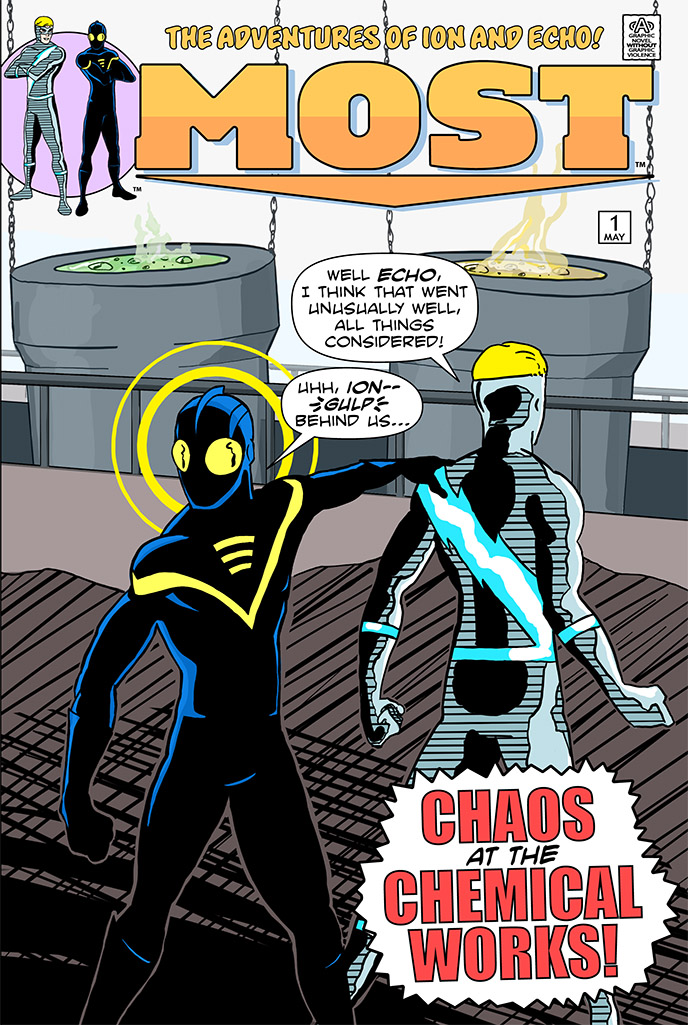
MOST  (updated each Monday) is the odd title of a webcomic written, drawn, colored, etc. by eighteen-year-old Richard Nyquist.

Before you ask, I've searched in vain for an explanation of the name, but so far haven't really received one.  I suppose the basic idea is that just as "most" is a superlative word, the two teenage superheroes (Ion and Echo) upon whom the comic focuses are also superlative.  

Nyquist makes clear that his protagonists are fairly new to the super-gig, describing his work as "kind of a coming-of-age type story."  The first two issues seem to be tracing an arc of how the boys will handle  being "left in charge" of crime-fighting in Skyhill City, when its premiere superhero Safeguard departs to "another corner of this galaxy" to intercept an emerging (but unspecified) planetary threat. 


In addition to shared Christian convictions that come through in the wholesomeness of his work, another thing I appreciate about Nyquist is his homage to the classic comics format.  A prime example is his inclusion of a "letters page" following his first issue.  Yes, it's nothing but a reformatting of emails and blog post comments...but there's just something about it that warms my heart and takes me back to being that little kid who had the world at his fingertips and hours of fun ahead of him anytime his parents dropped a mere 75 cents for an escape into superherodom.


MOST is a colorful, fun adventure with bombastic battle sequences between our bantering heroes and their dastardly foes. And while Ion and Echo aren’t the most skilled or powerful guys on the block, they’re not going to let that stop them!

If you're looking for a light, fun, wholesome superhero comic this is a good option.  This comic is available to everyone for free, but it does cost time and money to produce. If you find something you like here, consider tossing a few shekels into Nyquist's Patreon account in gratitude.
 

Sustainability - 2
Despite the fact that the comic is only about seven months old, Nyquist has kept up a pretty consistent posting schedule.  This leads me to believe the sustainability of this comic at least deserves the original rating I gave to Miss Melee

Language - 5
Thanks (I assume) to Nyquist's Christian convictions, the language in Most is very clean and kid-friendly.

Violence - 5
The "violence" in here is so mild and cartoon-y I don't really think it's worth worrying about. (Nyquist's homage to the old Comics Code Authority seal--inset in the upper right corner of the cover image--proclaims itself a "graphic novel without graphic violence." Unless you thought the old Filmation stuff like He-Man and the Masters of the Universe was too violent, you won't find anything objectionable here. 

Sexuality - 5
Again, I can see no reason to worry about inappropriate sexual themes/imagery here.  I'd have no hesitancy about letting my kids read this.

Political Leanings - 3
Though two issues may not be enough to get a full picture, thus far Nyquist doesn't appear to be pushing any identifiable political position.

Morality - 3
I feel like the "3" rating here deserves some explanation.  It's not that there's any bad morals being promoted in Nyquist's work.  Rather, it's just that there's not a lot of overtly-expressed moral messages.  Personally, I much prefer that to clumsy self-righteous moralizing.  This is a sensitive area and one in which "less-is-more" is a solid rule of thumb.  
Bottom line:  I appreciate Nyquist's light touch here. 

Artwork - 1
The sole weak spot of Most is the artwork.  I hesitate to write that sentence, as Nyquist is doing everything himself (and his artwork is still a sight better than anything I could produce).  Doing it all alone and maintaining a weekly posting schedule could very well be creating constraints that keep him from bringing his "A game."  My unsolicited advice would be that Nyquist look for an artist to bring on board, allowing him to focus his energies more in terms of crafting his story arc. 

Storytelling - 2
With the caveat that I'm evaluating the storytelling with only one issue complete, I can say that it's acceptable...but not great.  Honestly, that may be coming...especially if (as it appears) Nyquist's adopting the model of unrolling stories slowly over an arc, it could well be that the richness of his tale simply hasn't been revealed yet. 

Overall Rating: 3.0

Femme Noir: a review of chapters 1-7

Overview & Rating

Christopher Mills' and Joe Staton's Femme Noir is another of those comics that straddles the line between hard-boiled detective and superhero (e.g., Spirit, Midnight, the Question, etc.).  What is a little unique, however, is that none of the other fedora-ed and trench-coated heroes--at least, not in their original iterations--were female.

The stories are set in the appropriately grim-sounding Port Nocturne.  The mystery of the heroine’s identity functions as a macguffin to keep the reader’s interest--at least that’s what it did for me. This is no mere oversight, but rather a crucial part of Mills’ and Staton’s story-telling strategy:

When this story first appeared...a number of reviewers, accustomed to comic book characters having colorful monikers, mistakenly began referring to the mysterious heroine of Femme Noir as “Blonde Justice.” To set the record straight, the character is never called “Blonde Justice” or even “Femme Noir.” She has no name at all. Various characters may call her “The Blonde,” or other descriptive appellation, but our mystery woman has no super-hero codename, “Blonde Justice” or otherwise. (Mills, C. (2013, August 21). Blonde justice: page two.

While playing their cards so close to the vest is initially enticing for the reader, I certainly hope Mills and Staton either reveal more in print, or have plans to do so in the future.  Otherwise, at some point the effect of their tactics shift from being intriguing to irritating.

The webcomic is currently divided into seven stand-alone stories, characterized by a diversity of storylines/threats.  The heroine faces off against gangsters, genetic monsters, robots, jungle warrior women, and more!

Sustainability - 2
Femme Noir started as one feature of the website Supernatural Crime in 2001, and made its print debut in The Dark City Diaries.  In August 2013, the webcomic version (of at least some) of the stories was introduced. Unfortunately, it came to a rather abrupt halt in June 2016 when Mills reported:

The computer where these files were stored isn’t working right now, and I haven’t had the resources to get it repaired. Hopefully, we’ll be able to finish it soon. Sorry. (Mills, C. (2016, October 6). An eye for a spy: page seven.

Given that that was over a year ago--and there's still no resolution--I'm skeptical that we'll see any more free Femme Noir.  

Language - 3
Some of the themes dealt with in Femme Noir are psychologically dark.  Not surprisingly, this leads to dialogue that includes cursing, as well as referring to God in a rather flippant manner.  

Violence - 4
The violence of FN matches its dark genre. Port Nocturne is no sunshiney world...nor are the people who inhabit it.  

Sexuality - 4
There is a certain amount of sensual imagery (e.g., lounge singer Dahlia Blue, or the heroine's fishnet stockings) but I don't see much reason to be concerned about kids being exposed to inappropriate images/innuendo.

Political Leanings - 4
FN participates in the familiar noir theme of ineffective police forces and corrupt local government. (see here)   Though the heroine stands outside the system--in the attempt to ensure justice for those who fall through the cracks--she stops short of issuing a blanket condemnation of the entire municipal order.

A secondary theme one could call “political” is the feminist theme.  Through the seven chapters, I cannot recall any instance where the villain is a female.  Though there are some good men depicted in the work (e.g., Lt. Riley) they typically come across with some sort of regrettable flaw (e.g., well-intentioned...but impotent).  Overall, I’d feel pretty comfortable describing this as a feminist work.

Morality - 4
There is a certain eye-for-eye-and-tooth-for-tooth perspective on justice; yet I wouldn't say the heroine acts exclusively as judge, jury, and executioner.  One has the sense--at least sometimes--that the fate of Port Nocturne's citizens (the good, the bad, and the ugly) is being determined by a Higher Power.

Artwork - 5
Staton spent years honing his craft at Charlton, Marvel, and DC...and it shows.  While I personally prefer comics with more vibrant colors, for the type of story FN is, Staton hit the nail right on the head.

Storytelling - 4
The storytelling is good, if a bit quirky.  The tales frequently seem to focus on everyone except the heroine.  As often as not, she is more of a deus ex machina for resolving the problems of the other characters.  

Overall Rating: 3.75

Individual Chapter Synopses

Blonde Justice

In the first story, the reader eavesdrops on a reporter mulling the true identity of the heroine.  He has three suspects: orphaned mob daughter Vanessa DeMilo ; lounge singer Dahlia Blue ; and ace reporter Laurel Lye.  Three short vignettes follow illustrating the reasons for thinking each might be the heroine.  Unsurprisingly, the chapter closes with no definitive answer regarding the heroine’s identity.  The only thing we do know, is that the Port needs her.


The Dingus

Chapter two follows the drama of an ancient and valuable mask (constantly referred to as a “dingus” by the narrating character) and the three-way race between private investigator Red “Rusty” Nales, millionaire K. Burton Smythe, and the heroine to acquire it.  


Dead Man’s Hand

The third story highlights the terrible burden of regret as gambling addict Roman Sidaris struggles to escape the debts owed to one, King Diamond; while hiding the shame of his addiction from his wife, Eden.  After Eden is murdered, it’s up to the heroine to seek justice for her, while simultaneously trying to free her husband from Diamond’s grip. 


This short story strikes one as an homage to the monster movies of the 1950s.  Playing the role of the mad scientist is Dr. Paul Carstairs, disgruntled chief chemist of Kieth Cosmetics.  Perceiving himself sleighted by his employer, Carstairs has orchestrated a number of assassinations-via-monster, until the intervention of the heroine.  


Common street thug Vic Tobor, survives a drive-by and stumbles into the laboratory of Dr. Otto Capek. The next evening, Miss Molly Gunn is called to identify the body of Tobor. One week later, she’s reading reports of a crime spree when a robotic figure steps from the shadows and reveals himself as the supposedly-deceased Vic.

While investigating the robberies, the heroine discovers Dr. Capek being held captive at Vic’s salvage shop hideout.  The conflicted Molly refuses to leave Tobor, but pledges she will do what she can to help the heroine free Capek. 

Unfortunately, Vic prevents the escape.  When Molly tries to intercede, Tobor ends up killing her simply because she shrinks away from his metallic touch.  The heroine taunts him, “You may have a big body now, Vic--but you’re still a very small man.” 


Concrete Jungle

500 years ago, a meteor rocketed toward the South Pacific.  So begins the story of the "Concrete Jungle," which sees a number of distinguished members of the Port Nocturne Adventurer's Society executed by a huge primitive-looking warrior woman. 

Meanwhile, our heroine is busy cleaning up the Port’s bottom-feeders when she spots the Stone Age assassin leaping from rooftop to rooftop.  When she overhears two policemen commenting on the triple homicide, she decides to investigate.  Ultimately, her investigation leads the heroine to the home of Professor Mycroft Powell.  

Powell relates that 18 months prior, he was part of a South Seas exploratory trip to a previously uncharted island believed to house the ruins of an advanced civilization...and lost treasure.  Mycroft claims that upon reaching the island, the party was set upon by monsters.  At the last moment, deliverance came in the form of a “magnificent [human] woman” and a tribe of reptillic anthropoids.

In the yarn Mycroft spins, he and the others encountered islanders lived in a “ramshackle village,” on a previously unknown island, from whom he “purchased” their prized possession--the Orb--in “a very amicable transaction.” Skeptical, the heroine nevertheless asks to be directed to the Orb’s current location.

The two avenging women finally meet at the warehouse where Mycroft had stashed the Orb.  Okona announces her intention to kill the thief and retrieve the Orb.  Initially, the heroine steps in to “prevent anymore bloodshed tonight,” but her battle banter with Okona causes the heroine to seriously question Powell’s version.  


An Eye for a Spy

The final tale introduces the short-lived Rex Devlin, Agent 09 of America’s Top Secret Division (TSD).  He is pursued by foreign agents, who corner Devlin in an alley when the heroine interrupts.  Gunplay ensues. Devlin and the heroine succeed in killing most of their attackers and forcing the final one, Luger, to flee.  Unfortunately, Agent 09 is mortally wounded in the fight.  

As Devlin lay dying he pleads with the heroine to, “complete my mission.”  The TSD had information on the spy ring's plans for a political assassination, but Devlin was intercepted before he could meet the informant and determine the target's identity.


We then cut away to a nondescript townhouse where the aforementioned Luger is reporting to his superior.  Luger assures his boss that Devlin is, indeed, dead...but explains that the intervention of the heroine accounts for rest of the strike team's absence.  The incredulous superior asks how this could possibly have happened, and Luger insists that, “She was no ordinary woman.”  

As of today (10/30/2017), the story ends abruptly with the final panel depicting the heroine standing outside a building entitled, the Casa Isabella (one presumes this may be the building in which Luger is meeting his superior.)