Pages

Catching the Infectious Lass Fever

As with virtually all Legionaires and affiliated characters, my introduction to Infectious Lass came from the Who's Who in the Legion of Superheroes series.  Consequently, this is her classic look as far as I'm concerned:


Okay, so she wasn't much to look at (unless you're into mucous) but I found her power set--and especially the backstory--terrifyingly cool.  Drura Sehpt (IL's real name) came from the planet Somahtur, where the dominant sentient life form gained its position not by conquering and destroying "lower" forms of life (i.e., bacteria, viruses, etc.) but through complex symbiotic evolution with them.

The upshot was that every Somahturian became a walking CDC virology lab.  Unfortunately, Somahturian symbiosis didn't play too well with off-worlders.  Your average Somahturian could  "quickly [and fatally] infect other living bio-organisms." (Infectious Lass. Comic Vine) So it's easy to understand why the United Planets kept a pretty tight quarantine on the planet, not allowing access to anyone other than a handful of select medical personnel. (Think about standard global protocols towards regions experiencing an Ebola, for example.)

Drura was atypically adventurous for her race, becoming one of the few to venture off-world.  Her would-be galactic road-trip suffered a delay, however, as she was confined for sometime to Medicus One...due to her [species' aforementioned] health risk to others. (Infectious Lass. Comic Vine)

When Drura was finally released she bee-lined it for a Legion of Superheroes tryout where she demonstrated her power by making Star Boy terribly sick. Unfortunately for Drura she had more power than control, and the Legion rejected her application due to safety concerns.

Superboy #201 MAR 1974
  

The Long-Term Substitute
Following her rejection by the regular Legion, Infectious Lass was recruited into the Legion of Substitute Heroes by Polar Boy.  She appeared pretty infrequently after that until the "Five Years Later" jump of1989.  Below is a listed compiled from Comicvine (excluding Who's Who and  other such "encyclopedic" appearances)
  
Possible inspiration?
Infectious Lass's 1974 debut may support a suspicion I've long-harbored--that her appearance owes something to the Andorians of Star Trek, who made their first appearance six years earlier in the episode "Journey to Babel."

Note the blue-skinned, antennaed chap in
the right background
Of course, blue skin and antennaes aren't exactly unprecedented tropes in science fiction.  I make no claim to have proven anything. This is only a speculation...but what say you?  Does it plausible to imagine that the Somahtur doesn't fall far from the Andoria?

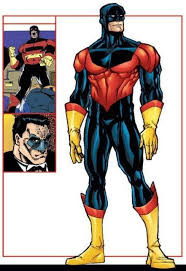
The two faces of the Crimson Avenger (Lee Travis)


The Crimson Avenger has the distinction of being the first masked hero produced by Detective Comics.  His debut came in October 1938 with Detective Comics #20.  While costume changes aren't exactly unprecedented in the superhero genre, they typically represent slight variations on a basic model. (Think, for example, of all the many costume changes the Wasp has had over the years.)

In the case of the Crimson Avenger, however, we see a pretty dramatic style change in either Detective Comics #40 (if you believe Wikipedia) or #44 (if you rely on Dave's Comic Heroes Blog). Unfortunately, as I am unable to access the innards of either of these classic tomes, I can't say definitively which is correct.

Regardless of when the change took place, I've only ever heard one explanation. It's claimed that the Avenger's altered duds were the natural response to popular taste shifting away from costumed vigilantes, and towards superheroes. And so, we went from this:

the more or less original look
to this:
the new look as of Detective Comics #40 (or #44)

While it's certainly possible that this was the rationale motivating the editorial decision, it doesn't make much sense to me.

First, marking a line between "costumed vigilantes" and "superheroes" strikes me as a distinction without a difference.  (Unless one were to define the difference as being violent vs. non-violent, or super-powered vs. non-super-powered individuals.)

Second, it seems to me there were a great many "costumed vigilantes" who remained as popular as the Crimson Avenger, without surrendering the business-attire-influenced look.  For example:

Sandman
Adventure Comics #60 MAR 1941
(though Sandman had
his own costume
change by May of the
next year)
Universal Studios poster
1941


Midnight
Smash Comics #54 AUG 1944

The Spirit
The Spirit #22 AUG 1950


So, essentially, I'm curious if anyone has ever heard an alternative explanation for the costume change; or at least a fuller fleshing out of the standard explanation to account for why it was felt Crimson Avenger had to change, when these other guys clearly didn't.

Unapologetic appreciation for Hauptmann Deutschland (Vormund)

To the best of my recollection, Captain America # 393 (JAN 1992) was my first glimpse at the character originally--and supremely, in my opinion--known as Hauptmann Deutschland.


This was a classic case of me being seized by the cover.  I had no idea who the guy on the front kicking Cap's shield was, but I knew I wanted to know more.

As it turned out, Hauptmann was yet another national super-hero built in the mold of Captain America.  (See my post on the Red Guardian for the Soviet counterpart).  In this case, the Hauptmann had a name that essentially translated to "Captain Germany."  Once you know that, the color scheme of his costume makes perfect sense.

This issue was part of a larger story arc in which Hauptmann, with fellow German heroes Blitzkrieger and Zeitgeist (man, I love these names!) were seeking to capture the Red Skull and his cohorts and try them for war crimes.  (I'd like to point out, here, that Hauptmann was fully convinced that this Red Skull was the Red Skull, even before Cap was!  Bear that in mind when assessing the merits of ole Hauptmann.)

Much like the Captain America #353 storyline, which featured the Red Guardian,  we again see a case of villains impersonating the Avengers (in this case, bioplastoids created by Arnim Zola).  The faux-Avengers demand that Hauptmann Deutschland and friends remand the Skull and his gang into their custody.  The German heroes reluctantly do so, though one wonders why.  The overall demeanor of the Americans--Cap especially--seems suspiciously out-of-sync with their public personas.


Back in America, a phone call comes into Avengers HQ inquiring about the status of the Skull's prisoner transfer. When Cap tells Jarvis he doesn't know any "Hauptmann Deutschland," der kapitan assumes he's been had, hangs up, and hops the next available transatlantic flight.

This, naturally, sets up the classic case-of-mistaken-identity-fight, when both Captains indepedently arrive at the Skull's former Washington D.C. base.

While it's reasonable enough to conclude that the Captain America that took the Skull wasn't legit, one wonders why Hauptmann didn't stay on the horn a bit longer with the Avengers...at least to give the real Cap a courtesy, "Hey-there's-some-dude-impersonating-you-just-thought-you-should-know" warning. 
Unfortunately--and despite my great respect for German quality control--the fight is rather one-sided. 

That face you make when Steve Rogers starts gratuitous trash-talking...
This is actually, rather a shame.  I feel like the Red  Guardian gets more respect despite being a virtual one-to-one parallel of Captain America in strength, skills, weapons, and costume.


At least Haupt is sans a shield and has his own unique (if somewhat low-level) superpower. 
[Hauptmann Deutschland] possesses the ability to absorb kinetic energy and redirect that energy at an opponent. By aiming this energy at an opponent's heart, he can kill them. Under normal circumstances, he uses this energy to provide himself with greater endurance in a battle, increase his speed and strength, and to repel attacks. On one mission, [Hauptmann Deutschland] wore a vest containing a variety of weapons, including a metal net encased in a ball, ball bearings coated in oil, and a cable gun. (Vormund. Comicvine)
I like that powers were subtle, but still enough to make him a respectable challenge (though, as I lamented above, the fight in Cap #393 was more one-sided than I felt justified).

So what's in a name...really? 
There's apparently been a fair bit of debate over the years about the best name for ole' Hauptmann Deutschland.  I'm just gonna say right off the bat that I prefer the original name.  He's a nationalistic knock-off of Captain America.  There's no reason his name shouldn't reflect that...nor is there any reason that simply being modelled on Cap means he couldn't develop in his own dimensions and be an interesting character.  Consider the Superboy knock-offs that populated the Legion of Superheroes (e.g., Mon-El, Ultra Boy, et al.)

Despite my opinions, the original name was abandoned.  The general consensus online is that this was due to German cultural sensitivities about having any German hero with a militaristic name.  That sounds moderately plausible...but I would suppose that German does still have a military of some sort, right?  They've got police.  Presumably, at least some of these law enforcement officials are respected.

As with the various name-changes doled out to the former Supreme Soviet, the transition to "Vormund" was a horrible screw up, in my opinion.  First, it doesn't roll-off-the-tongue any easier than Hauptmann Deutschland.  At least the very length of the original name signals that you're dealing with an official code name.  Vormund sounds like it could be the personal name of a barbarian warlord...or maybe "he-who-must-not-be-named."

Even if you try to examine the name from the perspective of a German, this change still doesn't make much sense.  First, I've read that the name Vormund in German actually means something like "legal guardian."  It's been proposed that a more faithful translation would be Wachtner.

Third, if the concern is that Hauptmann Deutschland was nothing more than a linguistic plagiarization...a formulaic adaptation of "Captain America," then I still don't get how Vormund is an improvement.  Remember, both Marvel and DC already have heroes named Guardian.  How is this a horrible transition:


But this is deep and meaningful?


Dreams for the Future

In addition to restoring Hauptmann Deutschland's original name, I'd love to see a mini-series entitled Patriots featuring Captain America, Hauptmann Deutschland, Captain Britain, Red Guardian, Collective Man,  et al.

While you might think that's nothing more than a pipe dream, I never would've guessed that Hauptmann Deutschland (yep, I refuse to use this stupid new name) would end up in a LEGO Superheroes feature, but here we are...